When Wayne Booth coined the phrase unreliable narrator in his 1961 book The Rhetoric of Fiction, he was giving a precise name to a trick storytellers had been playing for centuries. Readers arrive at a first-person story with a quiet default setting: unless the speaker sounds openly unhinged, we treat their account as the floor of the room. An unreliable narrator pulls that floor slightly out of level, so you only realise the slope once the furniture starts sliding across the page.
What makes the device durable is that it does not depend on a twist ending. Some of the sharpest unreliable narrators never lie outright. They simply notice the wrong details, flatter their own motives, or misread social cues in ways that feel uncomfortably recognisable. The pleasure is double: you follow the story the narrator thinks they are telling, while assembling a second, sharper story from the cracks around the edges.
The naive witness: Jane Austen and Arthur Conan Doyle
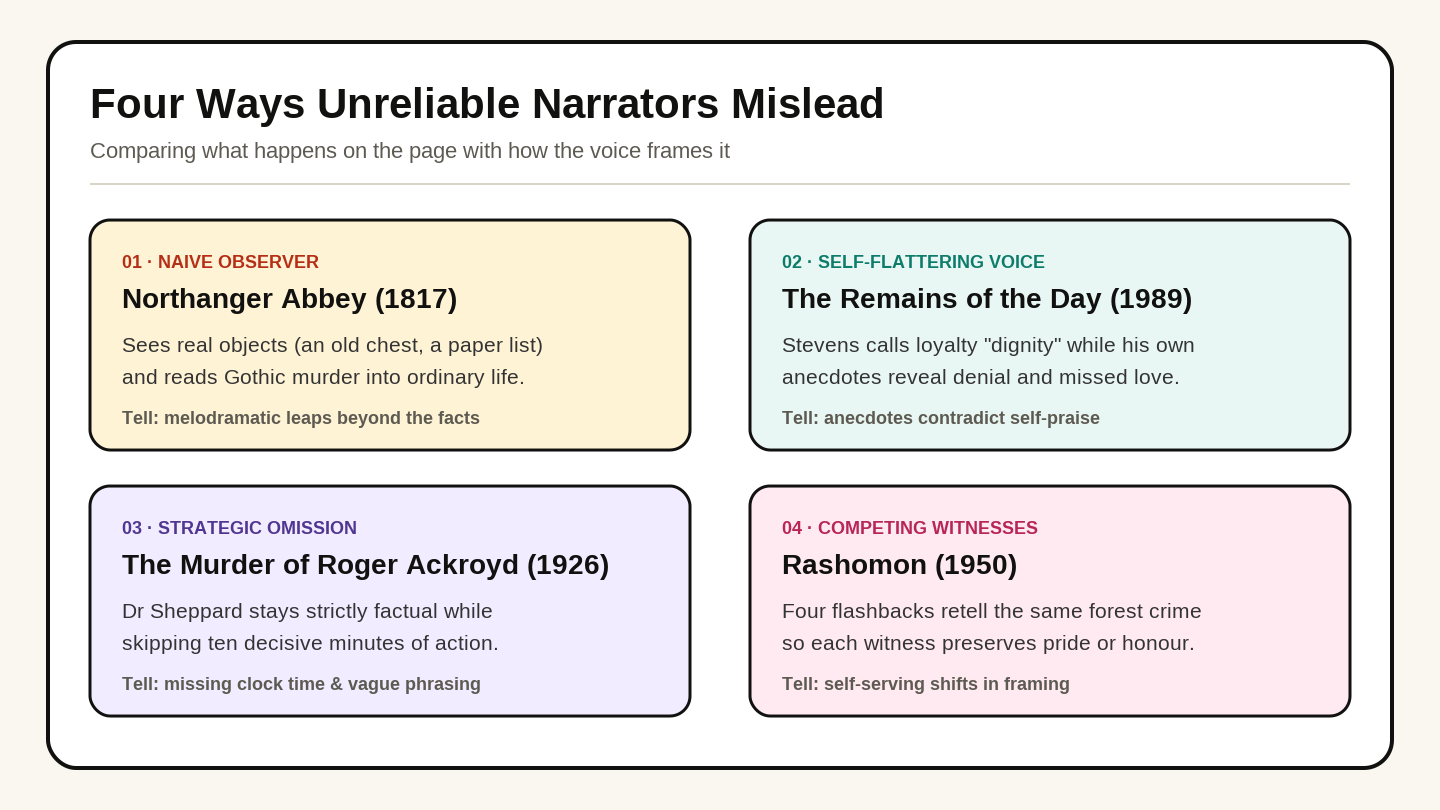
The gentlest form of unreliability comes from limited experience rather than malice. In Jane Austen's Northanger Abbey (1817), seventeen-year-old Catherine Morland arrives at a medieval country house saturated in Gothic novels. Every locked chest, drafty corridor and abrupt remark from General Tilney becomes proof, in her head, of a murdered wife hidden upstairs. Austen never needs Catherine to invent physical objects; the chest is real, the laundry list inside it is real, and the comedy lives entirely in the gap between observation and melodramatic inference.
Arthur Conan Doyle used a quieter version of the same architecture across fifty-six Sherlock Holmes stories. Dr John Watson is honest, observant and far from foolish, yet he reliably looks at the same mud-spattered boot or frayed cuff as Holmes and extracts the conventional conclusion. Watson is not trying to deceive the reader; his ordinary assumptions act as the screen against which Holmes's sharper reading of physical evidence stands out. When a narrator shares our blind spots, the reveal feels earned rather than arbitrary.
The self-flattering storyteller
A sharper strain appears when the narrator has something to protect. Ford Madox Ford's The Good Soldier (1915) opens with John Dowell calling his tale "the saddest story I have ever heard", before spending two hundred pages insisting he understood nothing about the affairs unfolding in his own drawing room. By the middle of the novel, readers have to decide whether Dowell is genuinely obtuse or performing innocence to avoid looking at his own complicity.
Kazuo Ishiguro pushed this register to a quiet extreme in The Remains of the Day (1989). Stevens, the head butler at Darlington Hall, frames his life as a monument to professional dignity. Yet the anecdotes he offers as proof of poise — continuing to pour wine downstairs while his father suffers a stroke upstairs, defending his employer's flirtation with 1930s fascism as mere gentlemanly hospitality — systematically convict him in the reader's eyes. Stevens never says "I wasted my life on the wrong loyalty." He gives you the receipts and leaves you to add up the bill.
Strategic omission and the detective contract
Mystery fiction turned unreliability into a formal puzzle. In 1926 Agatha Christie published The Murder of Roger Ackroyd, narrated by the village physician Dr James Sheppard. The controversy that greeted the book was not about whether a narrator could commit murder, but whether Sheppard broke fair play by withholding what he did during a crucial ten-minute interval. On a second reading, the prose is startlingly scrupulous: Sheppard writes that he "did what little had to be done" and moves straight to the hallway, letting the reader's habit of skimming over polite phrasing supply an alibi he never actually claimed.
That technique shows why omission is more effective than outright fabrication. A narrator who tells a flat falsehood that the text cannot verify feels like a cheat; a narrator who skips twenty seconds of clock time, changes the subject whenever a witness approaches, or reports their own words in crisp detail while summarising everyone else's objections in half a sentence leaves clues a careful reader can catch on the first pass.
Competing memories on screen
Cinema complicates unreliability because the camera looks objective. When a novel says "he struck me first", we know the sentence passes through a speaker's mind. When a film shows a flashback, viewers instinctively treat the image as documentary footage. Akira Kurosawa dismantled that instinct in Rashomon (1950), adapted from Ryunosuke Akutagawa's short story "In a Grove" (1922). Four witnesses recount the same encounter in a Kyoto forest, and each version arranges the lighting, swordplay and courage so the speaker looks either noble, tragic or blameless.
Modern thrillers and character dramas borrow directly from that split. Whether you are watching the duelling diaries of Gone Girl (2014) or tracking shifting loyalties in an ensemble drama, the tell is rarely a dramatic confession. It is the small mismatch between what a character claims they wanted and what their actions repeatedly cost the people around them. If you enjoy tracing how different roles bend a story's perspective, try our villain origin quiz or see where you sit in Hero, Antihero, or Comic Relief.
Three clues that expose a shaky narrator
Critics such as Ansgar Nunning have argued that unreliability is not just a property planted by an author, but a friction detected by readers when a narrator's claims collide with the surrounding evidence. In practice, three textual signals do most of the warning work.
First, watch for disproportionate emotional reactions: a narrator who insists for three paragraphs that an offhand comment "did not bother me in the slightest" is usually telling you where the bruise is. Second, compare direct quotes from secondary characters against the narrator's summary of those people; when sensible side characters keep looking alarmed or backing out of rooms, the narrator's self-portrait is cracking. Third, track concrete logistics — times, keys, letters, distances. Feelings can be spun endlessly, but physical timelines resist editing. Separate what actually happened on the page from how the voice wants you to feel about it, and almost every unreliable narrator gives themselves away long before the final chapter.
If you are reading a mystery or close-studying a novel for a book group, you can track those mismatches in our narrator evidence ledger (CSV).