Which Anime Protagonist Type Matches You?
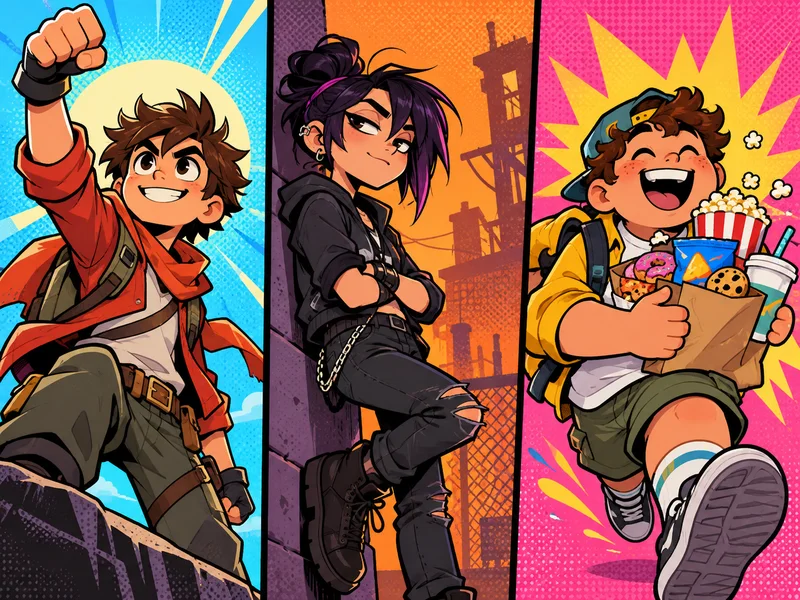
Long-running serialised adventure has developed its own set of leads, refined over decades by weekly deadlines and reader feedback. Each type carries a different engine: effort, talent, obligation, calculation or care. The plot bends to fit whichever one is in the driving seat.
Four questions about how you handle setbacks, training and the moment somebody hands you responsibility you did not ask for. The result names your protagonist type. Below it, a short piece on how these stories are actually made, including publishing categories that are widely misunderstood outside Japan.
See all the outcomes this quiz can land on, and what each one means →
Shonen and shojo are not genres
This is the most commonly repeated misunderstanding about Japanese comics, and it is easy to correct. Shonen, shojo, seinen and josei are publishing categories defined by the intended readership of the magazine a series runs in, not by content. Shonen means boys, shojo means girls, seinen and josei denote adult men and women respectively. A magazine's category tells you who the publisher is aiming at and therefore something about tone and marketing, but it does not tell you the genre.
That is why you find horror, sports, courtroom drama, cookery and romance running side by side under the same label, and why plenty of series aimed at one demographic are read overwhelmingly by another. Treating these words as genre descriptions leads people to make confident predictions about a series that turn out to be wrong roughly half the time.
The weekly survey shaped the stories
Japanese weekly comic anthologies have long included reader questionnaires, and the results have real editorial consequences. A serial that ranks poorly for a sustained run can be brought to a close quickly; one that ranks well gains pages and prominence. Working under that system trains a particular craft habit: end each instalment on a question the reader wants answered, because the survey is effectively a vote taken every four days.
One famous editorial formula, associated with the best-known of these magazines and reportedly derived from reader surveys in the 1960s, distils the preferred ingredients to three words often translated as friendship, effort and victory. It is not a rule that every serial obeys, and some of the magazine's biggest successes have bent it hard, but it explains why the training sequence and the loyal team are so persistent.
Limited animation was an economic answer
When weekly television animation began in Japan in the early 1960s, the budgets available made full animation impossible, so studios developed a repertoire of techniques to stretch every drawing: holding a cel for several frames, animating only a mouth or a pair of eyes, panning across a detailed still, reusing stock cuts for recurring actions. The result was fewer drawings per second than a feature would use, and it became a recognisable visual language rather than an obvious compromise.
Those constraints hardened into style. The dramatic held pose, the slow push on a static face, the speed lines instead of a moving figure: all began as ways of protecting a schedule and are now deliberate expressive choices used by studios who could easily afford to animate the shot fully.
As for the result you just received, a quiz has no way of telling you which lead you resemble, and the categories above are writing tools rather than descriptions of people. Take the one that made you nod and leave the rest.
Research notes & further reading
The explanatory section above was checked against this reading trail.
- How Character Archetypes Actually Work — BuzzGoing background article
- Vladimir Propp, Morphology of the Folktale (University of Texas Press)
- Joseph Campbell, The Hero with a Thousand Faces (Princeton University Press)
- Alan Dundes, 'Folkloristics in the Twenty-First Century', Journal of American Folklore
More quizzes to try