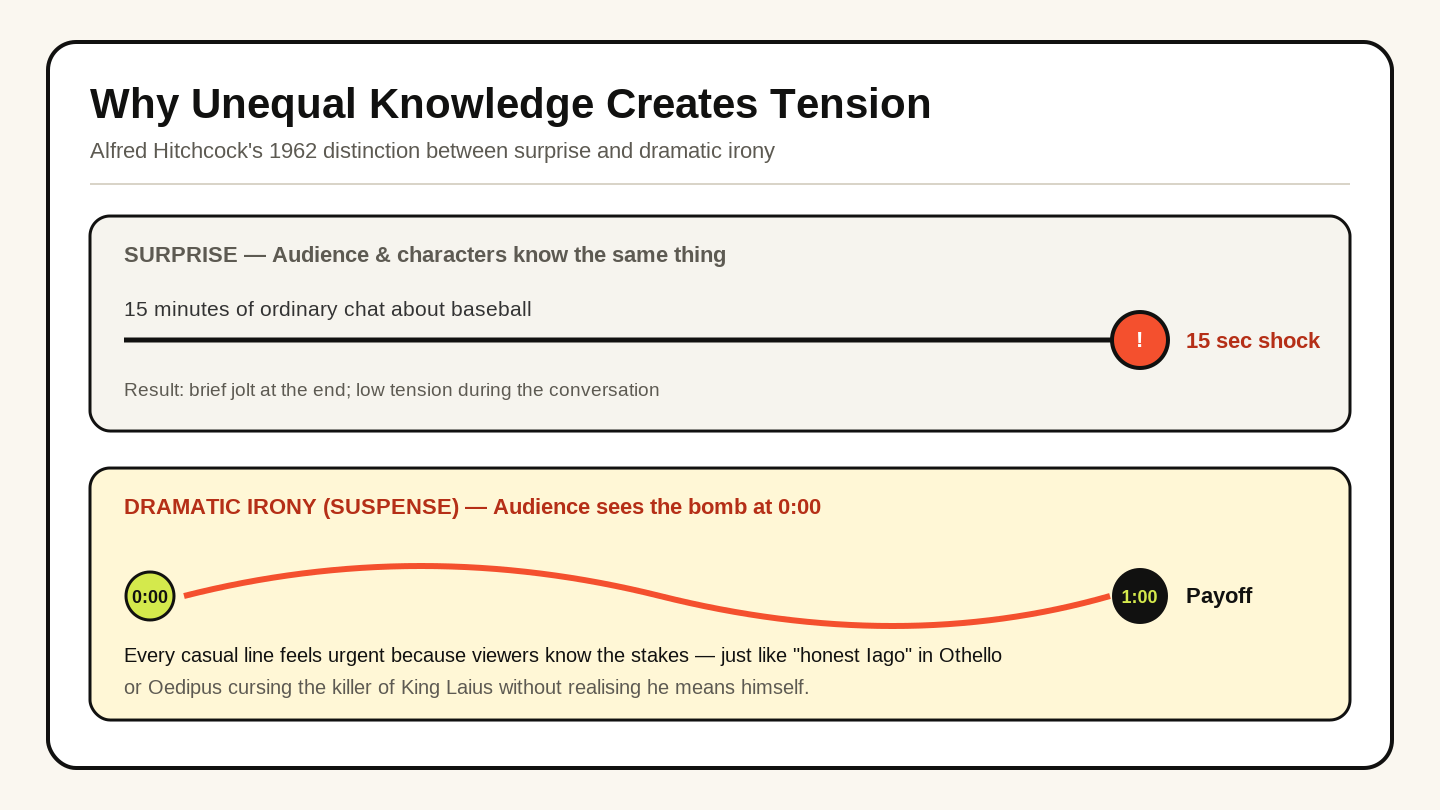
In his famous 1962 interviews with François Truffaut, Alfred Hitchcock explained the difference between surprise and suspense using a single prop: a bomb hidden under a table where two people are having an ordinary conversation about baseball. If the bomb explodes without warning, the audience gets fifteen seconds of shock. If the filmmaker shows the audience the bomb first, with a clock ticking towards one o'clock, the exact same conversation about baseball becomes fifteen minutes of unbearable tension. Every casual remark makes you want to shout at the screen.
That imbalance of information is dramatic irony, and it is one of the oldest engines in theatre, literature and cinema. Whenever the audience holds a concrete fact that at least one character on stage does not know, ordinary dialogue splits into two layers at once: the harmless meaning the speaker intends, and the collision course the audience can already see coming.
Sophocles built an entire tragedy on it
Ancient Greek theatre relied on dramatic irony almost by default because audiences already knew the myths before they sat down in the amphitheatre. Nobody walked into Sophocles' Oedipus Rex around 429 BCE wondering how the plot would turn out. The grip of the play comes from watching Oedipus solemnly curse the unknown killer of King Laius while every spectator knows he is pronouncing sentence on himself. When he mocks the blind prophet Tiresias for lacking sight, the audience hears the bitter pun before Oedipus can comprehend it.
That early example destroys a common misconception about spoilers. Knowing the underlying truth does not ruin tension; it changes the question from what will happen? to when will they realise, and what will they break before they do? Because the audience cannot intervene, helplessness turns into investment.
Shakespeare played it for both tragedy and farce
William Shakespeare demonstrated that the exact same information gap produces opposite emotions depending on the stakes attached to the secret. In Othello (c. 1603), Iago tells the audience his plans directly in soliloquy. Every time Othello calls him "honest Iago" — a phrase repeated so often it becomes physically uncomfortable to hear — the spectator watches a loyal general walk willingly into a trap built out of a stolen handkerchief and selective insinuation.
Flip the stakes from murder to pride, and the same structure powers comedy. In Much Ado About Nothing (c. 1598), Benedick hides in an arbour while his friends deliberately speak loudly enough for him to overhear that Beatrice is secretly heartbroken over him. A scene later, Beatrice hides in the same orchard and hears the mirror image. Because the audience watched the prank being planned, every stiff posture and sudden bout of romantic poetry from the two confirmed cynics plays twice as funny. Hans Christian Andersen used a similar public mismatch in "The Emperor's New Clothes" (1837), where every courtier knows the loom is empty, assumes everyone else sees silk, and performs admiration until a child collapses the shared illusion.
Why modern television cannot stop using it
Serialised television thrives on asymmetric knowledge because it stretches across episodes rather than minutes. In Breaking Bad, Hank Schrader spends seasons hunting Heisenberg while sitting at backyard barbecues with his brother-in-law Walter White. Each time Hank complains about the elusive chemist or jokes about the initials "W.W." in a lab notebook, the camera lingers on Walter's face and the audience does the arithmetic. The tension does not require a car chase; a dinner table is enough when one person knows the secret and the other holds a badge.
Comedy series use the mirror strategy. In sitcoms built around ensembles — from Fawlty Towers to Arrested Development — characters routinely talk past each other using the same words for two completely different situations. The viewer sits slightly above the room, watching two trains approach the same junction on a single track. If you like unpacking how cast roles distribute secrets and blind spots, see our guide to the ensemble formula or try In a Six-Person Ensemble, Which Seat Is Yours? and What Role Would You Play in a Fairy Tale?.
When dramatic irony breaks down
The device has one fatal failure mode: if a character could clear up the misunderstanding in ten seconds simply by asking an obvious question, tension curdles into irritation. Critics often call this the "idiot plot", a phrase popularised by Damon Knight and Roger Ebert for stories that keep moving only because every character refuses to communicate like a functional adult.
Durable dramatic irony always protects the gap with a believable barrier. Othello cannot easily verify Iago's claims because Iago controls the timing and preys on Othello's insecurity as an outsider in Venice. Benedick and Beatrice cannot confront each other directly because admitting affection would cost them the witty armour they have spent years sharpening. In Hitchcock's dining room, the diners have no reason to look under the tablecloth. Give the characters a solid reason not to know, make the cost of discovery unmistakable, and a quiet exchange over tea can hold an audience tighter than an explosion.
Writers and readers analysing a scene can map who knows what at each beat using our information-reveal worksheet (CSV).
Dramatic irony beyond the stage
The exact same structure turns up in documentary editing, historical writing and even sports broadcasting. When a director cuts to a replay showing a marathon leader has missed a turn while the commentator is still describing their comfortable margin, viewers experience a miniature burst of dramatic irony. In historical biographies, readers know the Titanic will strike ice or that the stock market will crash in October 1929 while reading cheerful letters written in August. That hindsight gives ordinary everyday sentences a poignancy the writers never heard themselves.
Interactive games experiment with dramatic irony more cautiously because the player usually controls the protagonist. If the player knows a smiling ally is about to betray them, forcing the player character to walk blindly into the ambush can feel frustrating rather than tragic. Games that pull it off — such as Spec Ops: The Line or BioShock — invert the pattern, letting the player share the character's assumptions until a late reveal exposes how much information was sitting in plain sight all along.