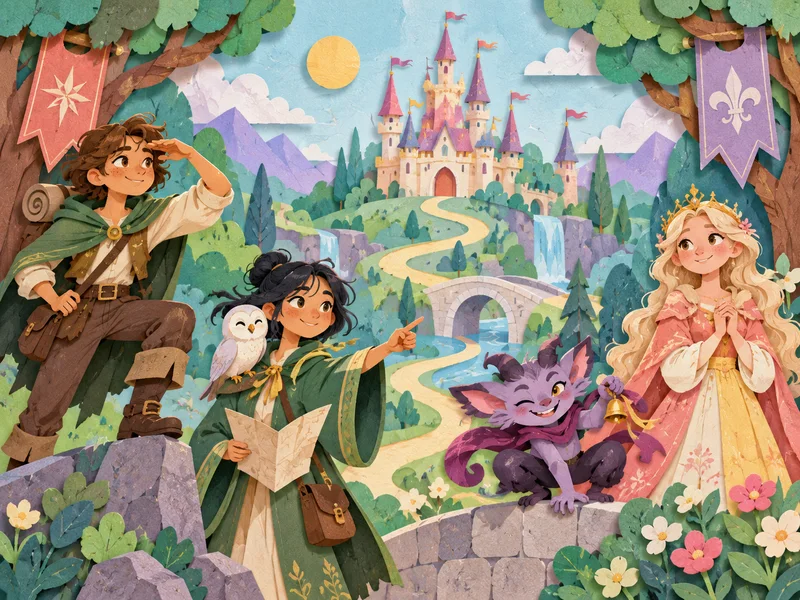
Count the people in the casts you have actually become attached to and a suspicious number will come out at five or six. Not four, which feels thin, and not nine, which feels like homework. The recurrence is not superstition and it is not entirely accident; it is what you get when you optimise a group for three separate constraints at once, and it turns out those constraints have been studied by people who had no interest whatsoever in television.
An ensemble is a set of doors
Start with what the structure is for. A single protagonist offers an audience exactly one way into a story: you either find that person interesting or you leave. An ensemble converts the same material into a set of parallel offers. Some viewers arrive for the competent one, some for the disaster, some for the pair who cannot be in a room together. The story does not have to be universally appealing; it only has to contain somebody for each viewer, which is a far easier specification to meet.
This changes what the writing job is. In a single-lead story you develop a character. In an ensemble you develop a set of relations, and the individuals matter mostly as the terminals of those relations. Contemporary narrative theory has moved in a similar direction, with work in the journal Narrative on character networks and plot structure treating casts as systems of connection rather than as ranked lists of importance. That is the correct instinct for anyone building one. Ask not who these six people are but what happens in each of the fifteen pairings.
The arithmetic of fifteen pairings
Fifteen is not a rhetorical number. The count of distinct pairs in a group of n people is n(n-1)/2, and it grows unpleasantly fast. Four characters yield six pairings, five yield ten, six yield fifteen, eight yield twenty-eight. Every one of those pairings is a scene the audience will eventually expect to see, with its own dynamic that has to be distinct from the other fourteen, or the pairing is dead weight.
That curve explains the ceiling. At six the writing team can plausibly keep fifteen relationships alive across a season and give each of them a signature. At eight they cannot, and the symptom is instantly recognisable: characters who have no relationship with each other at all, who share scenes without a dynamic, and whose plots run in parallel without touching. Large casts do exist and can work brilliantly, but they nearly always solve the problem by subdividing into stable sub-groups that function as ensembles in their own right, rather than by asking the audience to track twenty-eight live relationships.
There is a floor as well as a ceiling. Below five, the geometry stops producing shifting alliances. Three characters give you three pairs and a permanent odd-one-out; four give you six pairs and a tendency to settle into two fixed couples. Five is roughly the point at which a group can re-form into different configurations week after week without repeating itself, which is precisely what a returning cast needs.
What the group researchers found
Small-group researchers stumbled onto adjacent numbers from a completely different direction. An experimental study published in Sociometry in 1970 examined how group size affects both performance and how members feel about the group, and reported that participants' preferred size clustered a little below five, with smaller groups leaving members feeling the group was underpowered and larger ones leaving them feeling crowded out of the conversation. The optimum shifted depending on the task, but the band was narrow.
The cognitive ceiling points the same way. George Miller's 1956 paper on the limits of our capacity for processing information is the most-cited statement of the constraint, and while its specific claims about the number of items that can be held in mind have been substantially revised since, the general finding has held up: the number of distinct things a person can track simultaneously is small, and smaller than we like to believe. An audience meeting a new cast is performing exactly that kind of tracking, holding names, faces, allegiances and unresolved arguments in mind with no ability to pause and revise. Six is comfortable. Twelve requires a chart.
The table
Ensembles almost always own a piece of neutral territory. A kitchen, a bar, a staff room, a particular sofa, a ship's bridge. Its function is not decorative and it is not primarily about production convenience, whatever else it may also achieve. It is the answer to a scheduling problem inside the fiction.
If six people have separate lives, any given pair needs a reason to be in the same room, and manufacturing reasons is expensive and eventually implausible. A shared space removes the requirement entirely. Anybody may arrive, at any time, for no stated reason, and the audience accepts it because the location has been established as the place where these people are. This buys the writers unrestricted access to all fifteen pairings without a single line of justification, and it lets the cast be broken up and reassembled at will.
The table has a secondary effect that matters more than it appears to. It creates a default state for the group, a baseline of everybody present and nothing in particular happening, which gives the audience a stable image of the ensemble as a unit rather than as a list of individuals. Attachment attaches to that image. Viewers do not simply like six people; they like the configuration, which is why the removal of one member is felt so disproportionately.
Rotating the load
The other structural necessity is a rotation system. Screen time is finite and characters decay without it, so serialised ensembles run interleaved storylines of different weights: a dominant thread, a lighter secondary one, occasionally a third that is little more than a running joke, with the assignments cycling so that everybody takes a turn at the front.
This is more than fair distribution. It is a mechanism for keeping fifteen relationships warm on a limited budget, since a subplot can bring together two characters who have not shared a scene in weeks, purely to keep that connection alive. Guidance for new writers, including the material published by BBC Writers, tends to stress this interleaving as basic craft rather than a stylistic option, because a returning cast in which the same two characters carry every episode stops being an ensemble within a season.
Rotation also protects against the commonest failure mode, which is the runaway favourite. A supporting character who lands unexpectedly hard exerts real gravitational pull, and the temptation to feed them is enormous. Giving in wrecks the geometry: the group tilts, the neglected pairings die, and the thing the audience actually became attached to, the configuration rather than the individual, quietly stops existing.
Which is exactly what the quiz exploits
All of which produces a peculiar side effect. A well-built ensemble is, structurally, a personality typology that the audience has voluntarily memorised. The characters have been deliberately differentiated along legible axes, they have been given consistent responses to shared situations across dozens of hours, and they cover the space between them without redundancy, since redundant characters get cut. That is precisely the shape of a classification system.
So when someone asks which of them you are, the question lands on ground the story has already prepared. You are not being asked to compare yourself to strangers; you are being asked to locate yourself in a small, well-spaced set of positions you already understand, using a vocabulary you share with everyone else who watched. The answer is contestable, because your friends have opinions about where you sit. It is flattering without being empty, because these are people the audience has chosen to care about.
Writers do not build casts in order to be turned into quizzes. But the discipline that makes an ensemble work, meaning sharp differentiation, consistent behaviour, and full coverage of the available space with no two people occupying the same spot, is the same discipline that makes a set of categories usable. Ensembles are quiz-shaped by construction. The quiz merely notices.