What Role Would You Play in a Fairy Tale?
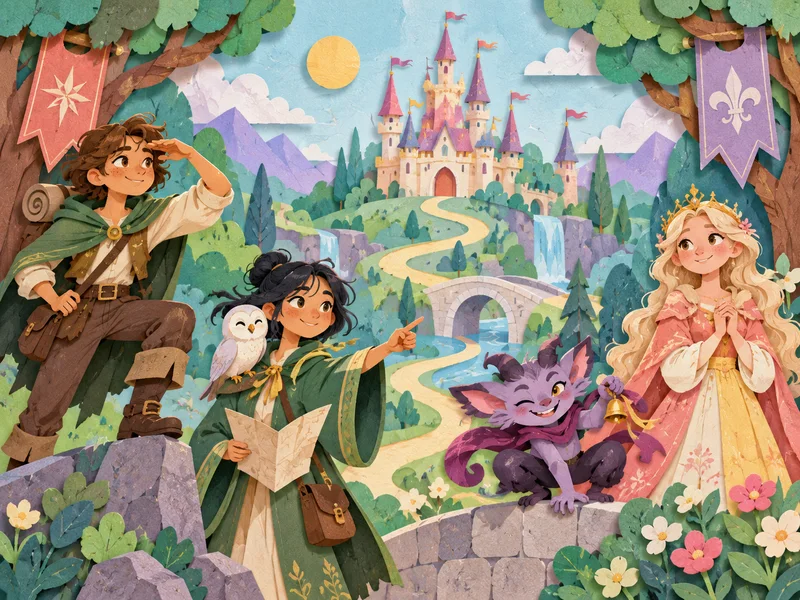
Old tales are built from a surprisingly short list of parts. Somebody leaves home. Somebody hands over the useful object. Somebody carries the message that starts the whole thing moving. The names and the scenery change from country to country, but the jobs stay stubbornly the same.
Seven questions about how you behave when a story kicks off around you: who you help, what you notice, and whether you would actually set off down the road. At the end you get one of five classic parts, plus a proper look at the research that first mapped them out.
See all the outcomes this quiz can land on, and what each one means →
Vladimir Propp counted the parts
In 1928 the Russian scholar Vladimir Propp published Morphology of the Folktale, working through a body of Russian wonder tales with something close to a botanist's patience. His conclusion was that the surface details of these stories are almost infinitely variable while their underlying structure is not. He identified thirty-one narrative functions, actions defined by their consequence for the plot rather than by who performs them, and found that although no single tale uses all of them, the ones that do appear tend to arrive in a stable order.
Propp then grouped those functions into seven spheres of action, which is where the character roles come from: villain, donor, magical helper, the sought-for person and her father, dispatcher, hero, and false hero. Crucially these are jobs rather than people. One character can occupy two spheres, and one sphere can be shared out among several characters, which is why the same tale type feels so different from village to village.
The wider mapping project
Propp's work sits inside a much larger cataloguing effort. The tale type index begun by Antti Aarne in 1910, revised by Stith Thompson and thoroughly overhauled by Hans-Jorg Uther in 2004, assigns numbers to recurring plots so researchers across languages can be sure they are discussing the same story. It is the reason a scholar in Helsinki and one in Lisbon can compare hundreds of variants without arguing about titles first.
What both projects reveal is that these tales were never authored in the ordinary sense. They were told, forgotten, half remembered and retold, and the versions that survived were the ones that were easy to carry in a human head. The structure Propp found is not a rule imposed on storytellers. It is closer to the shape that stories wear down into after a few centuries of being passed along.
Greimas and the six actants
Propp's roles were tightened further by the Lithuanian-French linguist Algirdas Julien Greimas, who proposed in the 1960s that any narrative can be described using six actants arranged in three pairs: subject and object, sender and receiver, helper and opponent. An actant is a position rather than a person, so one character can hold two at once and an abstract force such as a rule can hold one. It usefully separates who wants something from who set the wanting in motion.
Where a quiz stops being useful
Seven questions cannot assign you a role in anything, and the honest version of this page says so out loud. What the framework genuinely offers is a way of noticing patterns in how you behave when something starts happening around you: whether you move, whether you hand things over, whether you keep the record straight. That is worth a few minutes of thought. A label is not.
Research notes & further reading
The explanatory section above was checked against this reading trail.
- How Character Archetypes Actually Work — BuzzGoing background article
- Vladimir Propp, Morphology of the Folktale (University of Texas Press)
- Joseph Campbell, The Hero with a Thousand Faces (Princeton University Press)
- Alan Dundes, 'Folkloristics in the Twenty-First Century', Journal of American Folklore
More quizzes to try