A comic page has no projector, no frame rate and no stopwatch. Every panel sits frozen on the paper at the same instant, yet you can look at a three-panel strip and feel a two-second slapstick stumble, or turn a graphic novel page and sense an entire afternoon draining away in silence. Comics pull off that illusion by converting time into space: the distance your eye travels across borders, speech balloons and blank margins becomes the rhythm of the scene.
Cartoonists figured out these grammar rules long before scholars wrote them down. In the early 1900s, Winsor McCay's Sunday newspaper strip Little Nemo in Slumberland stretched vertical panels taller and taller as Nemo's bed sprouted legs and walked across a city, forcing the reader's eye down the page to mirror the feeling of growing height and gathering speed. Four decades later, Will Eisner devoted entire chapters of Comics and Sequential Art (1985) to showing how the shape of a panel border acts like a musical tempo mark.
The gutter does the heavy lifting
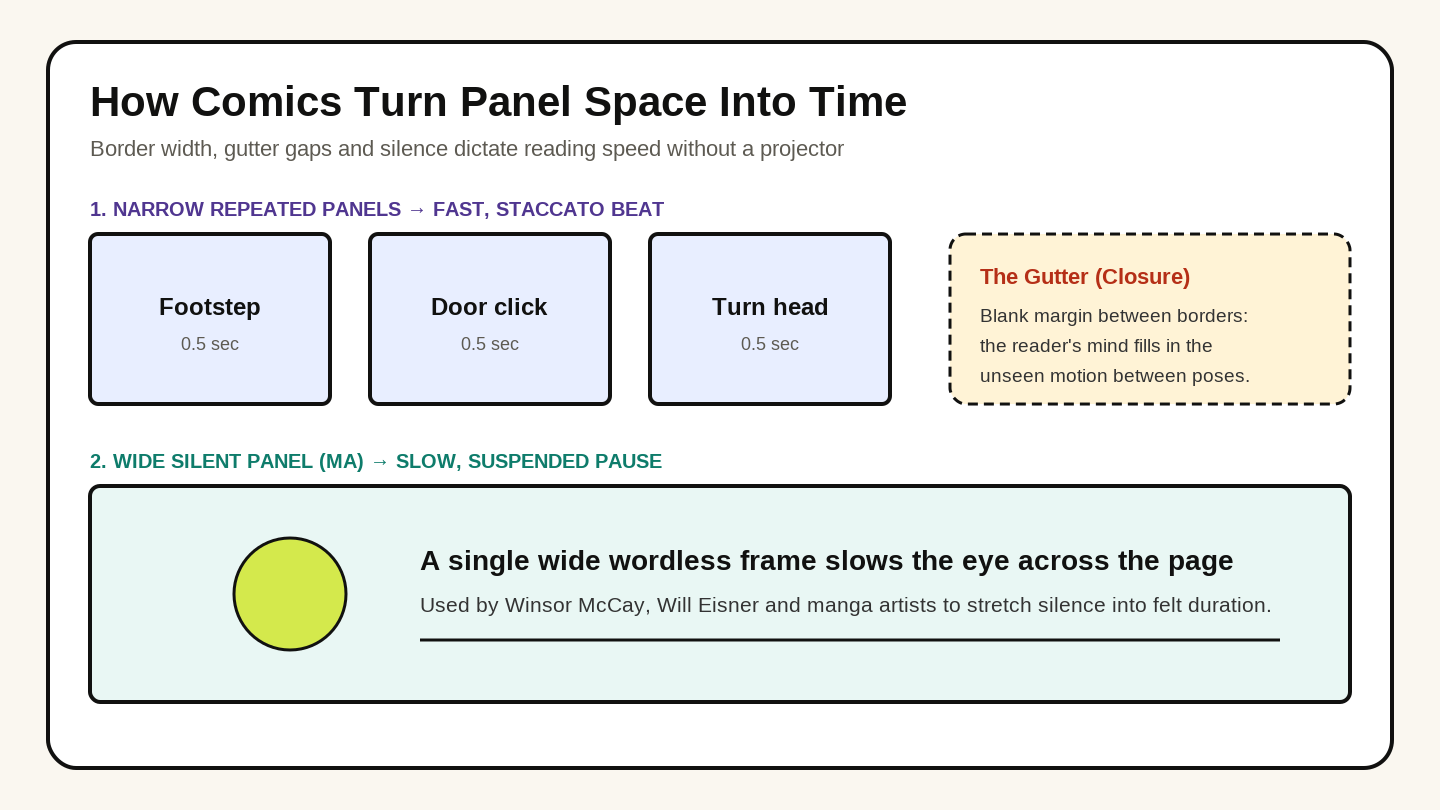
In Understanding Comics (1993), Scott McCloud focused attention on the strip of empty white space between panels — the gutter. Nothing is drawn inside the gutter, yet that is where the reader's brain connects two still drawings into a single continuous event. McCloud called this mental bridge closure. Show an axe raised in panel one and a scream over a quiet skyline in panel two, and the reader supplies the blow themselves.
McCloud sorted panel transitions into six families, and comparing how different traditions use them explains why Western superhero books and Japanese manga feel so different to read. American mainstream comics have historically leaned heavily on action-to-action and subject-to-subject transitions — punch, reaction, explosion, next room — packing maximum plot movement into a fixed 22-page monthly issue. Manga, often serialised in thicker weekly anthologies, devotes far more panels to moment-to-moment and aspect-to-aspect transitions: a wind chime swaying, steam rising off tea, a train crossing gate lowering before anyone speaks.
Ma: letting a page breathe
In Japanese visual storytelling, that deliberate pause connects to the aesthetic concept of ma — the meaningful interval between actions or sounds. Animators and manga artists such as Katsuhiro Otomo, Rumiko Takahashi and Hayao Miyazaki use wordless establishing beats not as filler, but as emotional calibration. A sudden silent panel of a character's hand hovering over a doorknob slows the reader's eye down far more reliably than a narrator caption declaring "she hesitated for a long time."
Speech balloons complicate this clock in a counter-intuitive way. A single silent panel can represent a split second — a camera flash or a snapped pencil — yet the moment a cartoonist puts two back-and-forth sentences inside one frame, that single image stretches to cover five or ten seconds of real conversation. Cartoonists call the clash between a frozen pose and a long monologue "balloon-time distortion": a character appears to hang mid-leap off a rooftop for twelve seconds while delivering a paragraph of exposition.
Panel geometry sets the speed
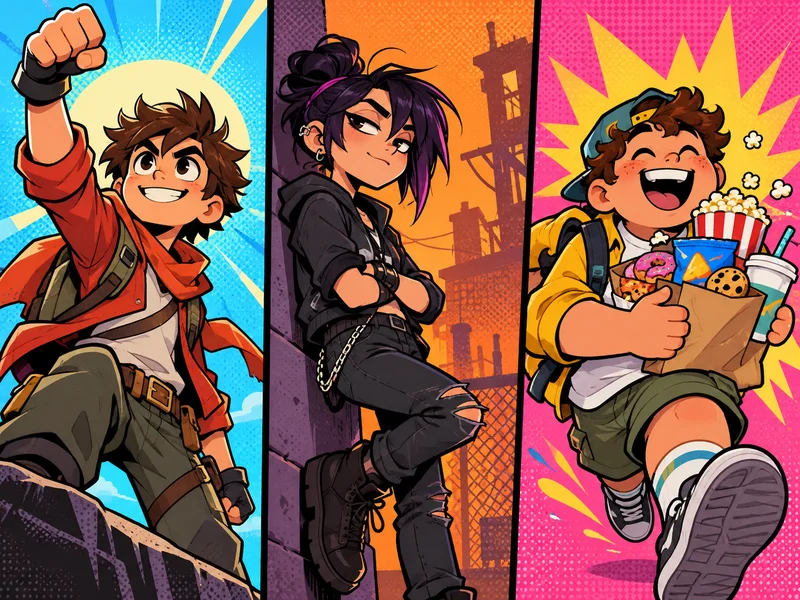
Even without dialogue, panel dimensions nudge how fast you read. A row of four narrow, identical panels creates a clipped, staccato beat — ideal for a ticking clock, footsteps down a stairwell, or a double-take. A wide panoramic panel asks the eye to scan horizontally across scenery, naturally decelerating the pace. Removing the border altogether in a full-page "bleed" lets an image spill off the edge of the paper, giving a moment a timeless, suspended weight that a tight black box refuses.
The physical turn of the page is the strongest punctuation mark an artist owns. Placing a small question or approaching shadow in the bottom-right corner of an odd-numbered page uses the reader's own hand to create a beat of anticipation before the full reveal hits on the top-left of the next spread. Webtoons designed for vertical phone scrolling replace the page turn with long vertical ribbons of empty colour, measuring suspense in thumb-swipes instead of turned paper. If you enjoy how visual framing shapes character and story, explore how animation makes a character readable in one frame, or try Which Anime Protagonist Type Matches You? and Which Animated Sidekick Are You, Really?.
Reading a page like a director
Next time a comic scene hits harder than expected, cover the speech bubbles with your hand and trace only the layout. Notice how many panels the artist spent on the setup versus the payoff, where the borders widen or vanish, and which action happened inside the gutter instead of inside the ink. A skilled cartoonist never draws every step of a movement; they pick the two or three silhouettes that make your own imagination animate the rest.
Sound effects and motion lines as clocks
Because paper makes no noise, cartoonists draw time directly into the air around moving figures. Speed lines radiating from a punch compress an instant into impact; multiple overlapping arms drawn inside one frame — a technique borrowed from Italian Futurist painting and refined in mid-century American strips — turn a single panel into a continuous smear of motion. Hand-lettered sound effects carry duration too. A sharp, angular CRACK! occupies a fraction of a second, whereas a wide, trembling RRRRRUMBLE stretched across three panels tells your ear the floor is shaking for several full breaths.
Even the colour palette participates in pacing. Watch how colourists in graphic novels such as Watchmen (1986–87) or modern European bandes dessinées hold a restrained, muted wash across quiet conversation panels and suddenly drop a single saturated red or acid-yellow frame at the moment of shock. The eye pauses longer on the chromatic jolt, slowing subjective time at the exact beat the writer wants remembered.