Ask players what actually makes them put a controller down in frustration, and the answer is rarely raw difficulty. People happily die four hundred times on a single screen of Celeste (2018) and call it one of the most welcoming games they have ever played, yet quit a far easier action game after three deaths because each retry forces them to watch a forty-second unskippable cutscene and jog across two empty hallways. The difference is not how hard the obstacle is. It is how much dead time sits between the checkpoint and the mistake.
Checkpoint placement is an invisible contract about what the designer wants you to practice. Every second between a respawn point and the point of failure is a tax. When that tax consists of meaningful tension or resource decisions, it raises the stakes. When it consists of walking up the same empty staircase for the twelfth time, it turns challenge into chores.
Three classic philosophies of the retry loop
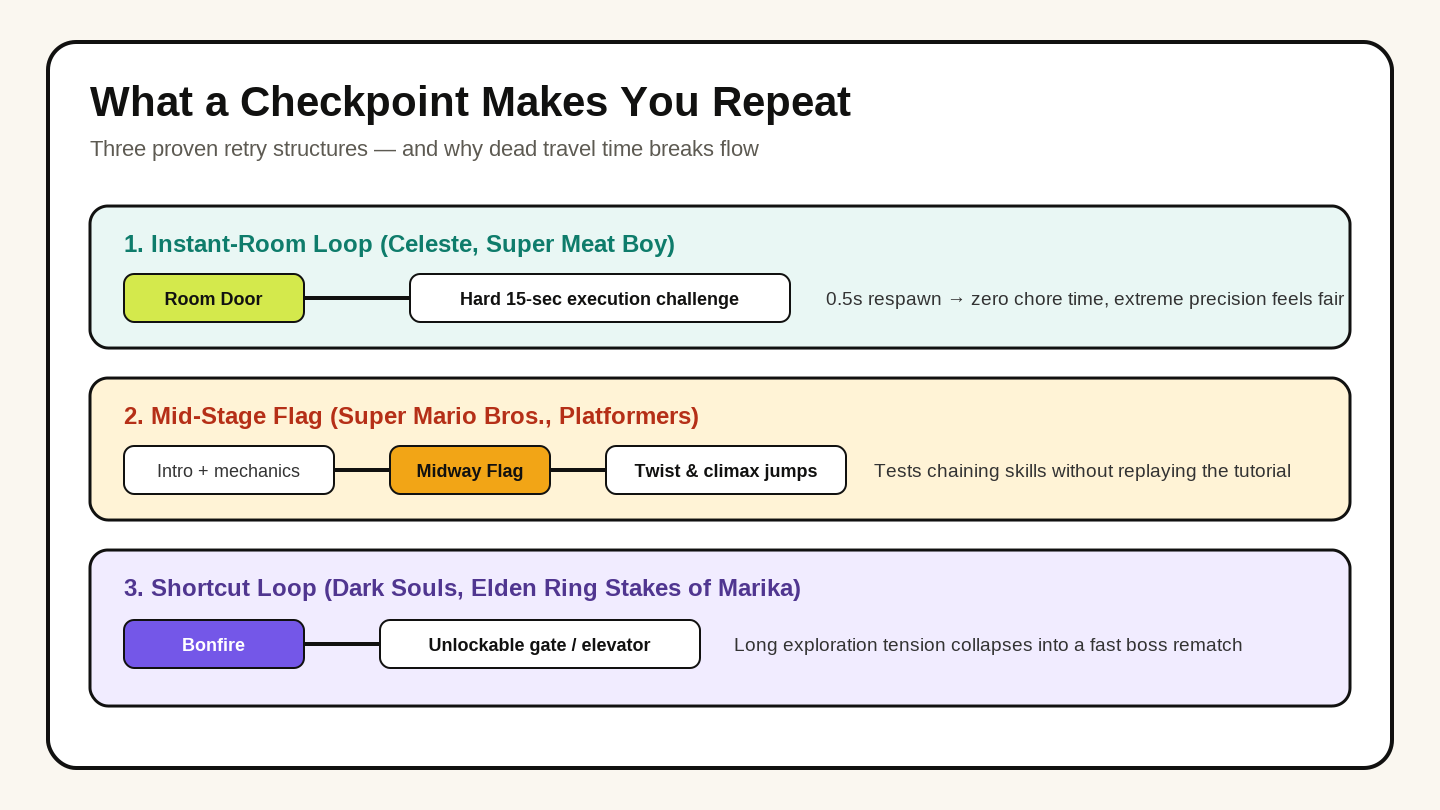
1. The arcade reset (high stakes, short run). Early coin-op games like Donkey Kong (1981) and NES classics like Super Mario Bros. (1985) inherited quarters-per-life economics. Yet even Shigeru Miyamoto knew pure restarts could stall players, so Super Mario Bros. quietly tucked invisible mid-level checkpoints halfway through most stages (later made visible as midway gates in Super Mario World). You still had to chain several jumps cleanly in a row, proving consistency rather than luck on one isolated leap.
2. The instant-room loop (Celeste and Super Meat Boy). Precision platformers flipped the equation completely. In Super Meat Boy (2010) and Celeste, dying returns you to the door of the exact room you failed in under half a second — no loading screen, no "Game Over" jingle, no lost lives counter. Because failure costs almost zero time, the designers can ask for acrobatic precision that would feel sadistic in a game with ten-minute runbacks. The game even tells players on a postcard screen to be proud of their death count, reframing failed attempts as ordinary drafts.
3. The shortcut loop (Dark Souls and Elden Ring). FromSoftware takes the opposite bet — deliberately spacing bonfires far apart so tension builds as your healing flasks dwindle and your unspent currency grows. Crucially, though, Dark Souls (2011) offsets long gaps with looping level architecture: kick down a ladder or pull a lever from the far side of a locked iron gate, and a fifteen-minute trek suddenly collapses into a twenty-second shortcut. By Elden Ring (2022), FromSoftware went a step further and added Stakes of Marika directly outside major boss arenas, acknowledging that while exploring a dangerous dungeon benefits from scarce checkpoints, sprinting past irrelevant hallway guards before a forty-attempt boss fight does not.
What never belongs after a checkpoint
Players forgive tough execution far more easily than broken pacing. Four mistakes reliably poison a retry loop: placing a checkpoint before an unskippable dialogue scene or camera pan; putting an easy five-minute tutorial corridor right in front of a sudden one-hit-kill trap; saving right after a player has already burned all their health potions with no way to recover (soft-locking their progress); and wiping out settings or weapon loadouts on reload so you have to re-equip your gear every single try.
Psychologists Richard Ryan, Scott Rigby and Andrew Przybylski found in their 2006 Self-Determination Theory research on video games that enjoyment tracks closely with perceived competence and autonomy. A well-placed checkpoint protects competence: it remembers what you already proved you can do and puts you right back at the edge of the skill you are still learning. If you want to see where your own patience gives out, try Where Exactly Is Your Rage-Quit Threshold? or How Steady Is Your Nerve in a Boss Fight?, and read why survival loops hook us.
Why checkpoints shape the memory of a game
When players remember beating a notoriously hard boss in Hollow Knight or clearing Farewell in Celeste, they remember the rhythm of iteration — trying a dodge, seeing why it failed, adjusting two frames earlier, and finally breaking through. The finest checkpoint systems stay almost completely out of memory themselves because they keep your attention locked onto the decision that actually matters.
How roguelikes turned the lack of checkpoints into a genre
Interestingly, an entire modern genre thrives by removing mid-run checkpoints altogether — and its success proves the exact same design principle from the opposite angle. In Hades (2020), Spelunky (2008) and Dead Cells (2018), dying sends you all the way back to the starting room. Why does that feel exhilarating rather than tedious? Because procedural generation ensures the rooms you replay are never the identical empty hallway, and every failed run feeds permanent knowledge, story dialogue or new weapon synergies back into the hub.
Compare that with an old-school linear game where dying to a third-stage boss forces you to replay forty-five seconds of identical, unskippable elevator rides. Players do not hate losing progress; they hate repeating solved, zero-decision tasks. Whether a game uses instant room respawns like Celeste, unlockable shortcuts like Dark Souls, or full fresh runs like Hades, the winning rule is identical: make the seconds immediately after respawn feel active, varied and respectful of the player's time.
If you ever build a small level in a community editor such as Super Mario Maker or Roblox Studio, test your checkpoint layout by deliberately failing each obstacle three times in a row. Time how many seconds pass between respawn and the actual jump or fight that killed you. Whenever more than ten seconds of that loop is flat walking with no risk and no choice, move the checkpoint forward until every retry starts right on the threshold of the real decision.