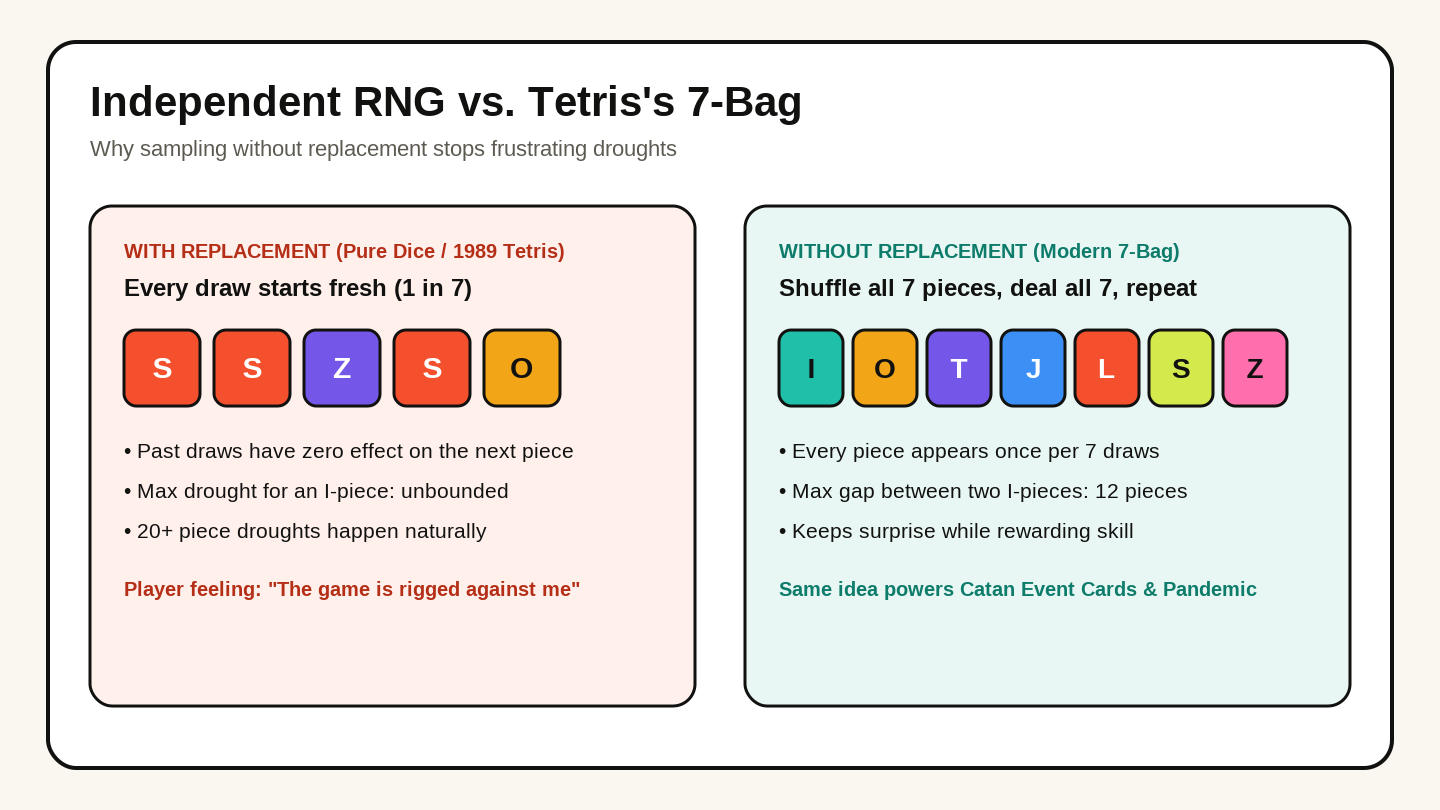
Play the 1989 Game Boy version of Tetris for half an hour and you will eventually stare down a well four blocks deep, waiting for a single long I-piece that refuses to arrive. You get three S-pieces, two Z-pieces, a square, another S-piece, and then game over. Nothing broke in the cartridge. Pure independent randomness genuinely produces runs of twenty or thirty pieces without a single straight bar — and to human players, true randomness feels like the machine is holding a personal grudge.
When The Tetris Company standardised modern rules in the 2001 Tetris Guideline, it threw pure randomness out the window. Modern Tetris uses a 7-bag randomizer: all seven tetrominoes are dropped into a virtual bag, shuffled, and dealt out one by one before a fresh set of seven is refilled. You can still see two I-pieces back to back (the last piece of one bag followed by the first of the next), but you can never wait more than twelve pieces for the block you need. That single change illustrates the most practical divide in game probability: sampling with replacement versus sampling without replacement.
Dice have no memory; decks and bags do
A fair six-sided die starts from scratch on every throw. Roll three ones in a row and the chance of a fourth one is still 1 in 6. In probability textbooks this is called independence; at a board-game table it is the source of the gambler's fallacy — the stubborn feeling that a six is "due". Games built on independent rolls accept wild streaks as part of the drama. That is why Risk can turn an overwhelming army of fifteen infantry into dust against two lucky defenders.
A shuffled deck or token bag behaves completely differently because every draw alters what remains inside. In Ticket to Ride, if four pink train cards have already been picked up, the pool of remaining cards is measurably thinner in pink. In Pandemic, the Infection Deck cycles through cities and then places the already-infected discards back on top whenever an Epidemic strikes, guaranteeing that danger clusters around familiar hotspots instead of scattering thinly across the globe. Sampling without replacement turns luck into a countable, readable horizon.
Why two dice change the shape of luck
Board-game designers have a middle ground between flat dice and depleting decks: summing multiple dice. Roll one six-sided die and every number from 1 to 6 lands 16.7 per cent of the time. Roll two six-sided dice, as in Klaus Teuber's Catan (1995), and there are thirty-six ordered pairs: only one combination makes 2 or 12 (2.8 per cent each), while six combinations make 7 (16.7 per cent). Even so, a single evening of Catan only contains forty to sixty rolls — far too small a sample for the bell curve to settle neatly. That is why the Catan: Traders & Barbarians expansion includes an optional Event Card deck of all thirty-six exact two-dice combinations: it guarantees the textbook distribution happens inside every single match instead of only across ten thousand matches.
When video games quietly bend the numbers
Digital games go even further because the computer can hide smoothing rules under the hood. Strategy fans know the sting of missing a displayed "95% hit" twice in a row in XCOM. Research into player perception — and post-mortems by designers at Firaxis and Nintendo — shows that people routinely treat an 80 per cent chance as "basically guaranteed" and feel cheated when it fails one time in five.
Several acclaimed studios adjust for this psychology directly. Beginning with Fire Emblem: The Binding Blade (2002), Intelligent Systems used a "two-RN" system: instead of rolling one random number from 0 to 99 against the displayed hit rate, the game rolled two and averaged them. That curved the probability so displayed chances above 50 per cent hit more often than advertised, while low-percentage desperation shots missed more often. Similarly, Dota 2 uses pseudo-random distribution (PRD) for critical strikes and stuns: each time an effect fails to trigger, its hidden probability climbs slightly until it fires, clamping down both endless droughts and unfair five-hit stun locks.
Choosing the right flavour of chaos
Neither pure dice nor 7-bags is universally better; each creates a different emotional promise. Pure dice produce unforgettable campfire stories precisely because absurd 1-in-1,000 comebacks stay possible. Bags, decks and pseudo-random counters reward long-term planning and protect competitive skill from freak droughts. If you want to test how your own instincts handle risk, frustration and mastery loops, try How Steady Is Your Nerve in a Boss Fight? or Speedrunner or Completionist?, or read how procedural generation actually works.
Next time a game feels unusually "fair" or strangely cruel, ask what container the randomness lives in. If the designer put it on a die, streaks are a feature of the math; if they put it in a bag, every unlucky draw quietly brings the card you need one step closer to the top.
Input randomness versus output randomness
Modern designers pair container choice with a second distinction popularised by designer Keith Burgun: input randomness versus output randomness. Output randomness happens after you commit to a move — you swing your sword in Dungeons & Dragons or take a shot in XCOM, and a die roll decides whether your plan succeeds or whiffs. Input randomness happens before you decide — in Slay the Spire, Into the Breach or Settlers of Catan, the cards dealt to your hand or the enemies' announced next moves set up a fresh tactical puzzle, and your choices execute deterministically.
Notice how often beloved modern games combine input randomness with a depleting deck. In Slay the Spire (2019), you draw five cards from your own shuffled deck each turn; once a card is played it goes to the discard pile and cannot return until every other card in the draw pile has had its turn. Players get the variety of surprise hands without ever suffering the helpless feeling that a key defensive card simply vanished into bad dice luck for ten turns straight.