Could You Survive Your First Week on the Island?
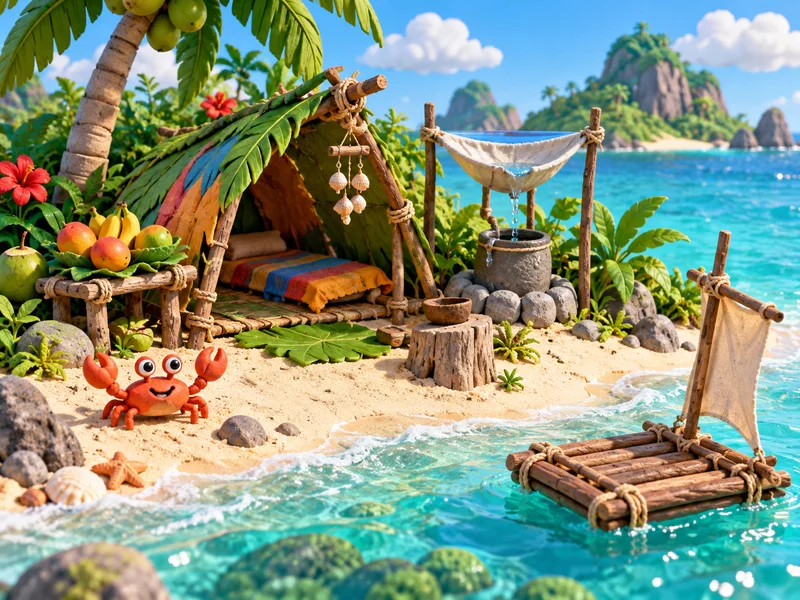
You wake up on sand with no tools, no map and no idea which way the wind usually comes from. What you do in the next hour tends to decide the rest of the week.
These five questions cover the standard survival curve: shelter, food, weather, tools, other people, and the moment you decide whether to stay put or push out. Answer with what you would genuinely do rather than what a well-prepared version of you would do, and the score at the end will be a lot more interesting.
See all the outcomes this quiz can land on, and what each one means →
The loop that built a genre
Modern survival games run on a short, legible cycle: read a meter, gather to fill it, then spend the surplus on something that keeps it filled for longer. The form crystallised in the early 2010s, when a mod for a military simulator dropped players onto a large map with hunger, thirst and no instructions, and showed that scarcity plus other people generates more story than most scripted campaigns manage. A great many studios noticed at once.
The ancestry runs deeper than that. Text-mode roguelikes had been modelling food clocks since the 1980s, and the crafting tree owes an obvious debt to tabletop design. What was new was persistence: a world that kept your camp standing while you were logged out, and other players who might come and look at it.
A meter is a timer wearing a costume
A hunger bar is not really about food. It is a clock that puts a price on every decision, which is why these games feel tense even when nothing is chasing you. Walk four minutes in the wrong direction and you have spent something you cannot get back. Designers tune the drain rate the way a composer sets a tempo: too fast and the game becomes administration, too slow and the world stops mattering at all. A well-tuned survival game keeps you permanently about twenty minutes away from a problem.
Why the finish line pulls harder than the start
There is a documented effect underneath the compulsion. Research on the goal gradient finds that effort rises as a target gets nearer: in a much-cited study of coffee loyalty cards, customers returned more often the closer they were to a free drink, and cards handed out with two stamps already filled were completed faster than shorter cards that started empty. Survival games are goal gradients stacked end to end. The shelter is nearly done, the smelter is nearly full, dawn is nearly here. Something is always at ninety per cent, and ninety per cent is where people stay up far too late.
One imaginary week is not a measure of you
Which is why a set of hypothetical beach decisions cannot establish whether you would cope. Most real competence in these games is memorised knowledge, and knowledge is learned rather than revealed: how many logs a wall takes, which plant is worth picking, how long a fire lasts unattended. Everyone plays their first week badly. The useful part is not the score but the question you hesitated over, because hesitation tends to mark the habit you actually have.
Research notes & further reading
The explanatory section above was checked against this reading trail.
More quizzes to try