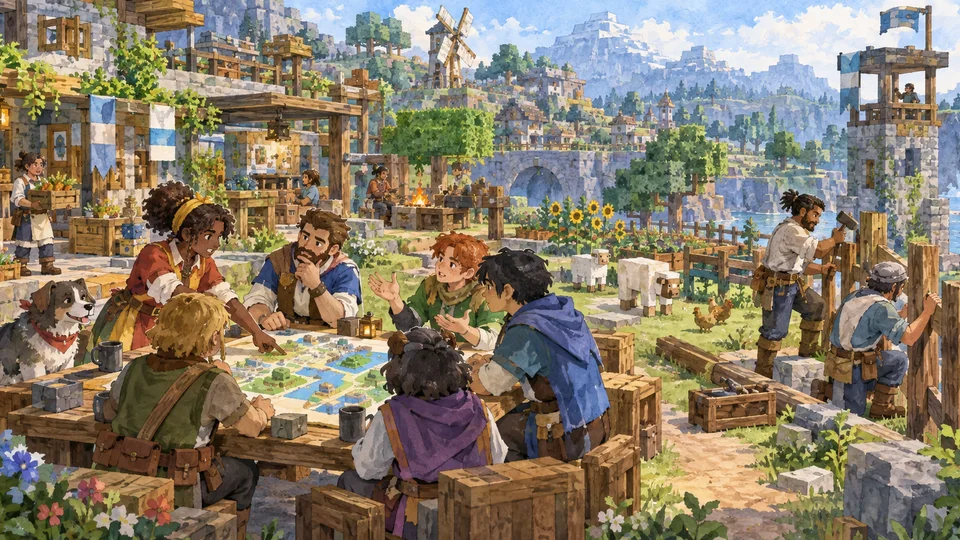
Put several thousand strangers in a shared space, give them property, scarcity and no police force, and something will organise itself. It may be a trade hub, a protection racket, a court of appeal with no legal authority whatsoever, or all three by Thursday. Persistent online worlds have been running this experiment continuously for three decades, mostly by accident, and the results are more instructive than the games' own marketing ever suggested.
Worlds with a measurable economy
The idea that a game economy might be worth studying properly arrived with force in 2001, when the economist Edward Castronova published a working paper analysing an online world as though it were a small country. He looked at what players produced, what they traded, and what their in-world currency fetched when sold for real money on external markets, and derived figures for hourly wages and output per head. The paper, archived at EconStor, treated virtual goods as economically real on the reasonable grounds that people were paying real money for them.
What made this more than a curiosity is that these economies are fully observable. Every transaction is logged. Every item's origin is known. Economists studying national economies work from samples, surveys and lags; a world's operator can, in principle, see everything. Some have leaned into it. The publisher of one long-running space game employs economists and publishes regular economic reports covering money supply, production, trade volumes and destruction, which is closer to a central bank bulletin than to patch notes.
The inflation problem nobody designs on purpose
Almost every persistent world eventually confronts the same monetary difficulty, and it follows from the genre's basic structure. Currency enters the world continuously, because defeating enemies and completing tasks generates money from nothing. That is a faucet. Money leaves the world only when players spend it on things the system absorbs, such as repair costs, taxes on trades, or consumables. That is a sink. If faucets outpace sinks, the money supply grows without a matching growth in goods, and prices climb.
The wrinkle is that the population is not uniform. Long-established players have vast reserves; newcomers have none. Inflation driven by the former sets prices the latter cannot meet, and the entry ramp quietly steepens until the world stops recruiting. Designers therefore spend enormous effort on sinks that feel voluntary rather than punitive: cosmetics, housing, consumable upgrades, anything that persuades wealthy players to burn currency for status. It is monetary policy conducted through interior decoration.
Item durability is the same instrument aimed at goods rather than money. If equipment never degrades or disappears, the total stock of it only ever rises, and eventually every player has everything, at which point crafting professions become worthless. Worlds that permit permanent loss of items tend to sustain healthier production economies and to be considerably more stressful to inhabit. That trade-off has no correct answer, only different populations who will tolerate different amounts of risk.
A further complication is that these economies are rarely sealed. Where in-world goods have value, a market outside the world appears to trade them for real currency, whatever the terms of service say. That external market imports a set of pressures the designers never chose. Effort inside the world starts being priced against wages outside it, organised production appears, and the operator finds itself policing a boundary it did not want to acknowledge existed. Castronova's original insight, that the two economies were already connected, has only become more obviously true.
Griefers and the norms that grow around them
Wherever players can affect one another, some will do so destructively for entertainment. The behaviour is old enough to have been documented in text-based worlds long before graphics: Raph Koster, who worked on several early graphical worlds, collected hard-won observations in The Laws of Online World Design, and one recurring theme is that players will use every affordance in ways the designers did not picture, including as a weapon.
What is genuinely interesting is the response. Communities under pressure do not simply wait for the operator. They generate norms: unwritten conventions about which areas are safe, what constitutes a fair fight, when it is acceptable to interrupt someone's work. They generate enforcement too, in the form of reputation systems that exist nowhere in the code. Being known as untrustworthy in a world where reputation is remembered can be a heavier penalty than anything the software would impose, because it costs you access to the cooperation that makes the world liveable.
This has a respectable theoretical home. Elinor Ostrom, awarded the Nobel Memorial Prize in Economic Sciences in 2009, spent her career documenting real communities that manage shared resources successfully without either private ownership or state control, and identified the conditions that make such arrangements durable: clear boundaries, rules that fit local circumstances, participation by the affected parties, graduated sanctions and accessible dispute resolution. Player-run alliances that survive tend to have rediscovered most of that list independently, usually after an expensive failure.
Three ways to police a world
Operators broadly choose between three approaches, and each has a characteristic failure. Coded prevention makes the bad act impossible: you simply cannot attack another player in this zone. It is reliable and it flattens the world, because a place where nothing can go wrong is a place where nothing much is at stake.
Staff adjudication puts human moderators in the loop. It handles ambiguity well, which code cannot, but it scales badly and consistency erodes as the population grows. It also transfers legitimacy problems onto the operator, who is now visibly making judgement calls about conduct.
Delegated authority hands enforcement to players, through elected officials, guild leadership, or tools that let groups exclude and sanction members. It scales beautifully and it reproduces every ordinary political pathology: factions, capture, patronage, and disputes about whether the rules were applied fairly. Most mature worlds run all three simultaneously and spend their lives adjusting the boundaries between them.
What happens when rules are player-made
The distinction that matters is between rules the software enforces and rules only the community enforces. A coded rule is absolute and unarguable, and therefore carries no moral weight at all. Nobody is praised for not walking through a wall. A social rule can be broken, which is exactly what makes keeping it meaningful, and it is the breakable rules that produce the drama, the treaties, the betrayals and the institutions.
Survey work on player motivation, notably Nick Yee's long-running Daedalus Project, consistently found that the social dimension of these worlds ranked among the strongest reasons people stayed, alongside achievement and immersion. People do not remain in a world for years because the loot tables are agreeable. They remain because they have obligations to other people there.
Which suggests the honest reading of these societies. They are not simulations of politics; they are politics, conducted with lower stakes and better logging. The stakes being lower is what makes them worth watching, because people will experiment with governance in a world they can leave in ways they never would in one they cannot.