Everyone learns in primary school that water boils at 100°C. Yet hang a wet towel on a washing line on a crisp 12°C autumn morning, come back four hours later, and the towel is dry. The water never came anywhere near 100°C, nobody lit a burner beneath the garden, and yet every gram of liquid turned into gas and vanished into the breeze. Everyday language lumps both phenomena together as "water turning to steam", which hides the neat physical difference between evaporation and boiling.
Temperature is an average, not a uniform speed
To see why a cool puddle disappears, zoom down to the molecules inside it. Temperature measures the average kinetic energy of billions of jostling water molecules, not the exact speed of each individual one. At any temperature — even just above freezing — molecular speeds follow a broad spread (the Maxwell-Boltzmann distribution). Most molecules move near the middle of the pack, some move sluggishly, and a fast-moving minority carry far more energy than the average.
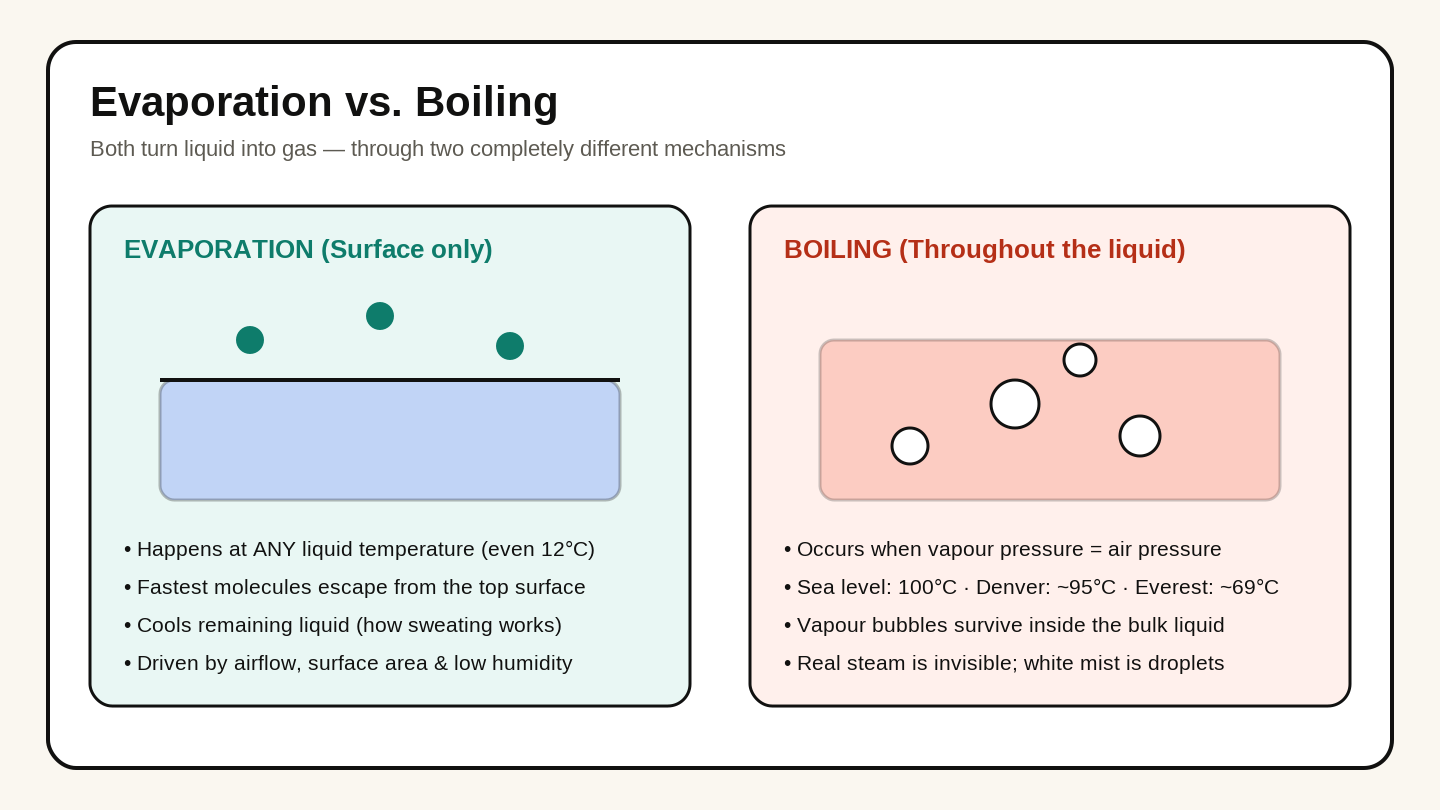
When one of those unusually energetic molecules happens to sit right at the exposed surface of a puddle and is headed upwards, it can break free from the attractive hydrogen bonds pulling it back toward its neighbours and escape into the air as water vapour. That is evaporation. It happens at any liquid temperature, strictly at the surface, and at a rate controlled by four familiar kitchen variables: temperature, exposed surface area (spread water into a thin film and it dries fast), airflow (wind sweeps escaping vapour away before it can bounce back in), and ambient humidity.
Why sweating cools your skin
Evaporation leaves an immediate consequence behind: because the fastest, highest-energy molecules are the ones that escape, the average energy of the remaining liquid drops. That is evaporative cooling. When you step out of a swimming pool into a gentle breeze on a warm day and shiver, the air is not suddenly freezing — departing water molecules are literally carrying heat away from your skin, roughly 2,260 kilojoules for every kilogram of water that vaporises. Human sweating exploits that exact energy tax to regulate body temperature, which is also why a humid 34°C day feels far more oppressive than a dry 38°C afternoon: saturated air slows net evaporation, jamming your body's radiator.
Boiling is a pressure contest, not a magic number
Boiling is a different mechanism altogether. Instead of individual molecules sneaking off the top surface, pockets of vapour form inside the bulk of the liquid as bubbles that rise and burst. For a vapour bubble to survive deep inside a saucepan instead of being crushed flat immediately, the liquid's internal vapour pressure must equal or exceed the surrounding atmospheric pressure pushing down from above.
At standard sea-level pressure (101.3 kPa), water's vapour pressure reaches that match at 100°C. Climb into the mountains where the blanket of air above you is thinner, and atmospheric pressure drops — so water wins the contest earlier. In Denver, Colorado (about 1,600 metres above sea level), water boils around 95°C; on top of Mount Everest it boils near 69°C, too cool to hard-boil an egg properly. A sealed pressure cooker runs the trick in reverse: trapping steam raises the pressure inside the pot, forcing water to stay liquid up to roughly 120°C so stews and dried beans cook in a fraction of the time.
That white cloud above the kettle is not steam
One last kitchen illusion trips up almost everyone. True water vapour — real gaseous steam — is completely invisible. Look closely at the spout of a furiously boiling kettle and you will see a clear, empty gap about a centimetre wide right where the gas rushes out. That invisible gap is the real steam. A centimetre further into the cooler kitchen air, the vapour condenses back into millions of microscopic liquid droplets suspended in the air, scattering light into the visible white cloud we casually call steam (the same way clouds and bathroom mirror fog form).
If you enjoy untangling everyday physical mechanisms that school diagrams glossed over, try our Everyday Science quiz or Which Weather Actually Lives in You?, or read the facts everyone repeats that turn out to be wrong.
Why a simmering pot refuses to get hotter than 100°C
Turn the hob under a boiling pan of pasta from medium to maximum and you might expect the water to heat up faster and cook the spaghetti sooner. In fact, once an open pot at sea level reaches 100°C, the liquid water inside stays locked right at 100°C no matter how hard you blast the flame. All that extra burner energy goes into latent heat of vaporisation — breaking intermolecular bonds to turn liquid water into gas faster, not raising the liquid's temperature.
You can spot that hidden energy budget in cooking everywhere. Browning onions or searing a steak relies on the Maillard reaction, which speeds up dramatically above 140°C. Crowd a frying pan with too many damp mushrooms, and the water they release keeps the surface pinned near 100°C until it evaporates away, leaving you with grey steamed food instead of a golden crust. Dry the surface first or give the pan room so moisture escapes rapidly, and the temperature finally climbs past the boiling plateau.
Meteorologists track the exact same balance on a planetary scale. Roughly eighty-six per cent of global atmospheric water vapour rises by gentle surface evaporation from the oceans — never from boiling water — powered by sunlight warming the top millimetres of sea surface. That invisible reservoir of vapour carries latent heat thousands of kilometres poleward before condensing into rain clouds and releasing its stored energy back into weather systems, driving storms, trade winds and the global freshwater cycle every day.